


Prof. S. Krishnakumar
Managing Director
Krishna Kumar Orthopaedic Hospital
Prof. S. Krishna Kumar is the Managing Director of Krishna Kumar Orthopaedic Hospital (KKOH), Nagercoil, and an experienced orthopaedic surgeon with over 40 years of expertise in orthopaedic care. He is dedicated to the diagnosis, treatment, and management of bone, joint, and trauma-related conditions. Through his years of clinical practice and commitment to patient care, he has helped establish KKOH as a trusted orthopaedic centre serving Nagercoil and the Kanyakumari region.
During hip replacement surgery, the surgeon removes the damaged hip joint and replaces it with a new one made of metal, ceramic, or plastic. The procedure typically takes one to two hours, and most patients can walk with assistance within a day, some patients even go home the same day. Most people regain independence in daily activities within six to twelve weeks, though full recovery can take six months to a year. Most implants last well, often between 20 and 30 years. People living in Kanyakumari district can now get this same quality of treatment near their own home.
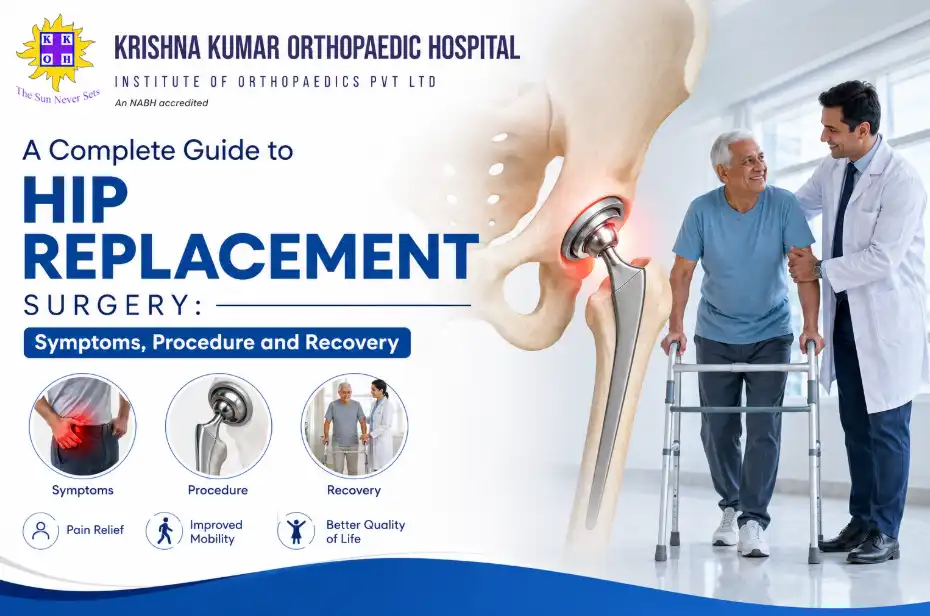
Total hip arthroplasty is another term for hip replacement surgery. This procedure puts in a ball and socket where your hip joint used to be. Surgeons take out damaged heads and old pelvic sockets. They replace them with parts made of metal, ceramic or strong plastic.
This process is looked for by many names, such as hip surgery, hip operation replacement, or just “new hip.” In every case, the goal stays the same. The goal of doctors is to get you out of pain, able to move again, and back to your normal life. For patients across Nagercoil and the wider Kanyakumari district, access to this kind of joint care has become much easier in recent years, with qualified orthopedic teams now available closer to home instead of requiring long trips to larger cities.
There is a delay before surgery. It’s generally suggested when other treatments don’t help control your symptoms. Keep an eye out for these:
Contact an orthopedic surgeon if these signs sound familiar, especially if physical therapy, losing weight, and painkillers have not helped.
In people osteoarthritis is something that wears down the cartilage in our joints. People who have rheumatoid arthritis have a disease that affects their system and it damages the tissue in their joints. Sometimes people injure their hip from falls or bad accidents. This can cause something called avascular Necrosis and what happens is that the bone does not get the blood it needs. There are some hip problems that kids can have when they are young. These hip problems can lead to long-term issues with their joints, like osteoarthritis and that is why osteoarthritis and other hip troubles are a concern.
It’s natural for people to ask this first. It takes about an hour to two hours to do the main surgery in the operating room. Anesthesia, getting ready, and healing in the post-anesthesia unit will take time, so you should plan on being in the hospital for a few hours to a few days.
When surgeons do this treatment a lot at hospitals with a lot of patients, the surgeries tend to go faster and the results are better. It normally takes longer for revision surgeries to replace an old implant because scar tissue and bone loss make the work more difficult. Patients who undergo revision surgery frequently report a longer hospital stay and a slower return to normal activity than they experienced after their first hip replacement.
This is what really happens during the surgery:
More muscle is spared when the approach is from the front, which can mean fewer limits right after surgery. Most people use posterior approaches, which work just as well, but they generally come with stricter hip precautions for the first six weeks to keep the hip from dislocating. A visual breakdown that was widely shared helped a lot of first-time patients visualize exactly how the implant fits into place. This made them feel a lot less anxious before the surgery.
Here is a realistic recovery time after hip operation, based on data from leading orthopedic centers:
|
Timeframe |
What to Expect |
|
Day 0 to 1 |
Walking with a walker or crutches, pain managed with medication |
|
Week 1 to 2 |
Physical therapy begins, short walks around the house |
|
Week 3 to 6 |
Reduced reliance on walking aids, driving may resume (often sooner for a left hip) |
|
Week 6 to 12 |
Return to most daily activities and desk work |
|
Month 3 |
Around 80% of patients return to daily activities without pain |
|
Month 6 to 12 |
Full muscle strength and complete recovery |
Age, overall health, and how closely you follow your physical therapy plan all affect where you land on this timeline. Younger, healthier patients tend to recover faster. Older patients or those managing other conditions may need more time.
Physical therapy usually begins within one day of surgery in hospitals. They want to get you on your feet and walking a bit. The physical therapy people teach you how to move without hurting your new hip. They help you get muscles around your hip and help you move your hip more.
Physical therapy is very important for people who have had hip surgery. People who do their therapy exercises tend to get better faster. If you miss some sessions or try to do much too soon it can slow you down. So you have to do the amount of exercise at the right time. Physical therapy is a part of getting better after hip surgery and it is very important to stick to your physical therapy plan.
Hearing from people who went through it adds a different kind of reassurance. Among patients in Nagercoil and across Kanyakumari, first-time patients often describe feeling nervous before surgery, then surprised by how quickly the original arthritis pain disappeared. Interestingly, most patients say the surgery itself wasn’t the hard part; it was adjusting to hip precautions and finding a comfortable new sleeping position in those first few weeks. By the three-month mark, many who had the posterior approach report feeling steady and largely back to normal, though a bit of muscle tightness can still linger.
These personal accounts line up with clinical data. Around 95% of patients report significant pain relief and a better quality of life after hip replacement.
There are risks with all surgeries. Infection at the incision site, blood clots in the leg, dislocation of the new joint (more likely with posterior approaches), implant wear over time, and small differences in leg length are all things that could go wrong. These risks are much lower if you follow your surgeon’s instructions and go to your follow-up appointments.
These days, implants usually last between 20 and 30 years, as long as there are no big problems. Implants keep lasting longer thanks to new materials like ceramics and improved metal alloys. Some people will need to have surgery again, especially if the first replacement was done when they were younger.
Most people reach basic independence in six to twelve weeks. Full recovery, including complete strength, takes six months to a year.
The operation itself takes about one to two hours.
Yes. Most patients stand and take a few assisted steps within 24 hours.
Typically one to two weeks for a left hip and up to four weeks for a right hip, depending on your surgeon's guidance.
Pain is managed with medication during recovery. Most patients feel far less pain after surgery than they did with their arthritic hip.
Hip replacement surgery works very well at easing pain and restoring mobility, and while the procedure itself takes just a short amount of time, recovery is a gradual process that depends on time and consistent physical therapy. Before making this decision, talk with an orthopaedic surgeon about your medical history, consider joining a patient community to learn from others who’ve been through it, and when you’re ready to take the next step, reach out to KKOH to book your appointment now .
Book a consultation at KKOH — the district’s most experienced orthopaedic centre.
kkoh.in | 04652-231418 | 9445161073
15/82E, Kottavilai, Overbridge, Parvathipuram, Nagercoil, Kanyakumari – 629 003
Our state-of-the-art facility combines advanced medical technology with compassionate care, making us the preferred choice for patients seeking specialized bone and joint treatment.
Copyright © 2026 KRISHNAKUMAR ORTHOPAEDIC HOSPITAL AND Private Limited Company – All rights reserved. Powered by Demanzo