


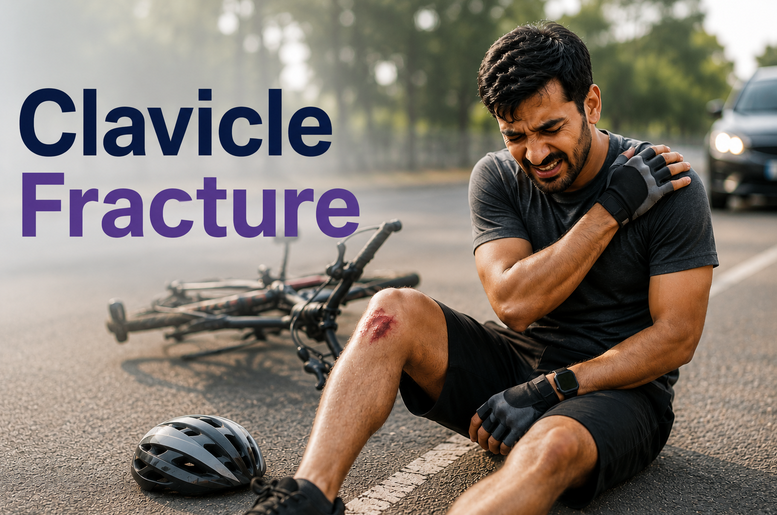
Quick Summary: What You Should Do Right Now
Immobilise the arm in a sling and go to an orthopaedic clinic or emergency room. Ask for an X-ray. If the fracture is displaced by more than 2 cm or there are multiple fragments, ask your surgeon about fixation options. Start physiotherapy as soon as your surgeon clears you. Do not rush the return to cycling, but do not delay physiotherapy either.
Clavicle fractures heal well when they get proper attention early. Most cyclists ride again, and most do so stronger than before, once the rehabilitation is done right.
Whether you are a road cyclist riding near Nagercoil, a mountain bike rider tackling the trails of Kanyakumari, or someone who simply rides every day in Tirunelveli, this guide has everything you need to know.
It covers what a clavicle fracture looks like, what treatment for a collarbone fracture involves, how long a clavicle fracture takes to heal, and when surgery for a collarbone fracture becomes necessary.
The collarbone is a bone that connects your shoulder to your chest. Because it sits just under the skin, any break is immediately noticeable and painful.
When you fall off a bike, your body naturally tries to protect itself by using your arm to break the fall. This force travels up through your arm and puts significant pressure on the collarbone, causing it to break. Also known as the clavicle, this bone is important because it connects the shoulder blade to the sternum.
When a cyclist gets hurt, one of the first things they usually do is search for answers online. The truth is, it depends on what the break looks like. Doctors who specialize in bones, called orthopedic surgeons, will study your X-ray images and assess several factors such as how displaced the bone is, whether it is shorter than it should be, the condition of the skin over the injury, and how many pieces the bone has broken into. Based on all of this, they can then advise you on the best course of action.
| Factor | Non-Surgical Treatment | Clavicle Bone Surgery |
| Fracture type | Undisplaced or minimally displaced | Displaced, shortened over 2 cm, or comminuted |
| Method | Arm sling 4-6 weeks + physio | ORIF with plate and screws |
| Return to cycling | 12 to 16 weeks | 10 to 12 weeks |
| Main advantage | No surgery risk; simpler recovery | Better alignment; lower non-union risk |
The important thing to understand about clavicle surgery is that it genuinely aids the healing process. When doctors use a plate and screws to fix the clavicle, it provides a stable base for the bone to heal on. Studies have shown that active people who have broken their clavicle in the middle section heal faster and experience fewer problems when they undergo surgery. So if your orthopaedic surgeon recommends surgery, they are not being overly cautious; they simply want to make sure your clavicle heals properly.
Clavicle fracture healing time varies by age, fracture type, and how well you follow your rehabilitation plan. Here is what a typical non-surgical recovery looks like:
| W 1-2 | Pain & Swelling ManagementRest, ice, and a broad arm sling. Clavicle bone pain is the worst in this phase. Sleep semi-upright with a pillow under the arm to reduce discomfort. |
| W 3-6 | Early Bone Callus FormationA soft callus begins forming around the fracture. You still wear the sling but start gentle pendulum exercises for the shoulder as directed. |
| W 6-10 | Strengthening PhaseX-rays confirm callus hardening. Active range-of-motion exercises begin. Neck collarbone pain and stiffness ease. Light daily tasks become manageable without the sling. |
| W 10-16 | Return to SportMost cyclists return to road riding around 12 to 16 weeks. MTB and contact sports typically require 16 to 20 weeks to ensure the bone handles impact safely. |
Surgical patients often move faster through this timeline because the plate holds the bone in position from day one, eliminating the risk of the fracture shifting during healing.
When you break your collar bone the muscles around it get hurt too. The trapezius, deltoid and pectoral muscles around the clavicle get really tight after the break. This can cause pain in the muscles around the collar bone that can last for weeks even after the bone is healed. This is a reason why cyclists feel stiff and weak when they try to start riding again.
You really need to do an exercise program to help these muscles. This is not something you can skip. If you do these exercises you can be back to riding your bike like normal in three months. If you do not do them you might still be feeling weak in your shoulders six months later.
Some cyclists say they have pain near the collar bone for a time after they get hurt. This pain can happen for a reason. The collar bone might not heal all the way, which is called non-union.. It might heal in a bad position, which is called malunion. The acromioclavicular joint can also get irritated. Cause pain.
If you still have a lot of pain near the collar bone four months after you got hurt you need to get an X-ray and see an orthopaedic doctor.
The collar bone might not heal even after you have been treated for a while. This is called non-union. This is another reason why you might need to have clavicle bone surgery even if it has been a month since you got hurt. The doctor can fix this problem by using a plate and some bone grafting, which usually works well for people who have non-union of the collar bone.
If you are somewhere in the tip of Tamil Nadu and you have just had a bike fall you do not need to go all the way to Chennai to get good orthopaedic care. The KKOH team sees a lot of clavicle fractures. They know what active patients like you need to get back on your bike.
At your meeting with the doctor the surgeon will take a X-ray of the clavicle fracture check how bad the break is, make sure your nerves and blood vessels are okay and then tell you what to do next: you will either get a sling and do some physio or you will need to have an operation with a plate to fix the clavicle fracture. The KKOH team will give you an answer and you will not have to wait for a long time. The KKOH team will help you with your clavicle fracture so you can get back to riding your bike.