


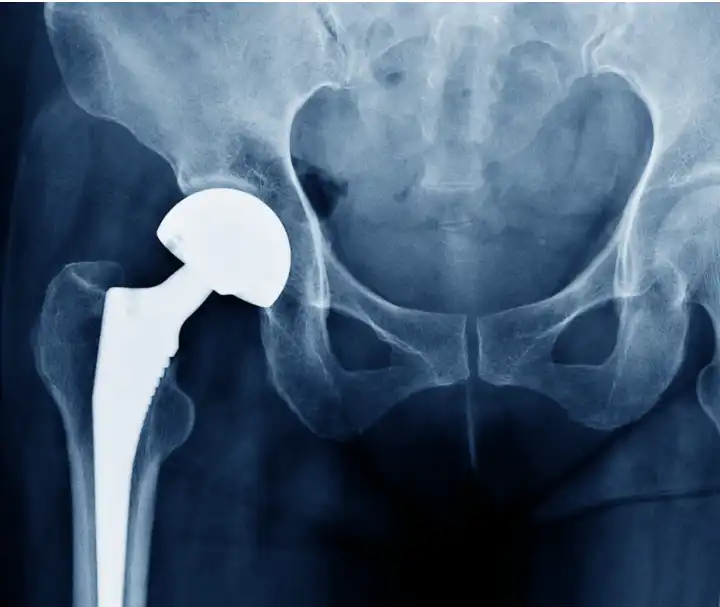
This is a surgery where both the ball and socket of the hip joint are replaced with artificial materials.
The normal hip joint consists of a cup called the acetabulum, into which articulates a head of the thigh bone called the femur.
This joint may become damaged due to a variety of conditions. The common causes are:
● Rheumatoid arthritis
● Ankylosing spondylitis
● Childhood diseases like Perthes disease
● Injury to the hip joint
There is loss of articular cartilage, a smooth lining of the ends of the bone in a joint. The result is that raw bones rub against each other, causing pain. This condition, where the articular cartilage is damaged, is collectively called arthritis.
Damage to the hip joint can occur at any age. Total hip replacement can be done after the age of 20 years.
There are three basic components in a total hip system:
The acetabular component may be made only of polythene material, or a titanium shell which holds the polythene cup.
There are two basic types of total hip system — cemented and uncemented:
● Cemented system: The components are fixed to the bone by a material called bone cement, which firmly fixes the components to the bone.
● Uncemented system: Does not use cement for fixation; instead, it relies on firm fixation by scratch fit.
There are various materials by which the head and cup are made:
● Stainless steel head + polyethylene cup: The older version. In this type of articulation, the head rubs against the polyethylene cup and wears out faster. The particles generated by this wear can damage the bone, causing loosening of the components — a condition called aseptic loosening.
● Ceramic head + ceramic cup: A promising material combination that is long-lasting, avoiding the complications above.
● Ceramic head + polyethylene cup: Also gives comparable long-term results.
On average, these materials are designed to last for more than 20 years.
The surgery is usually done under spinal anaesthesia. The procedure involves:
After implantation, the patient is kept under observation for a day or two in the post-operative ward. A drain may be inserted in the wound during surgery to drain any blood that collects, as an attempt to prevent infection. The drain is usually removed on the 2nd post-operative day. The patient may be given antibiotics and blood-thinning agents.
● By Day 4: Patient can typically start standing and walking with support
● First few days: Pain relievers are given
● Day 5: Patient is usually discharged
● 10 days after discharge: Patient returns for suture removal
There are a few potential complications in total hip replacement surgery:
● Blood clots (DVT): In the first two or three days after surgery, the patient may develop clotting of blood in the leg veins. Occasionally, this blood clot may travel to the lungs. Patients are given blood-thinning agents to prevent this complication. DVT stockings and calf muscle pumps can also help prevent it.
● Post-operative infection: Every step is taken to prevent this. At KKOH, strict sterilisation and aseptic procedures are carried out. Our infection rate is very low compared to international standards.
Total hip replacement is usually a promising surgery if done by an experienced surgeon taking adequate precautions.
Our state-of-the-art facility combines advanced medical technology with compassionate care, making us the preferred choice for patients seeking specialized bone and joint treatment.
Copyright © 2026 KRISHNAKUMAR ORTHOPAEDIC HOSPITAL AND Private Limited Company – All rights reserved. Powered by Demanzo